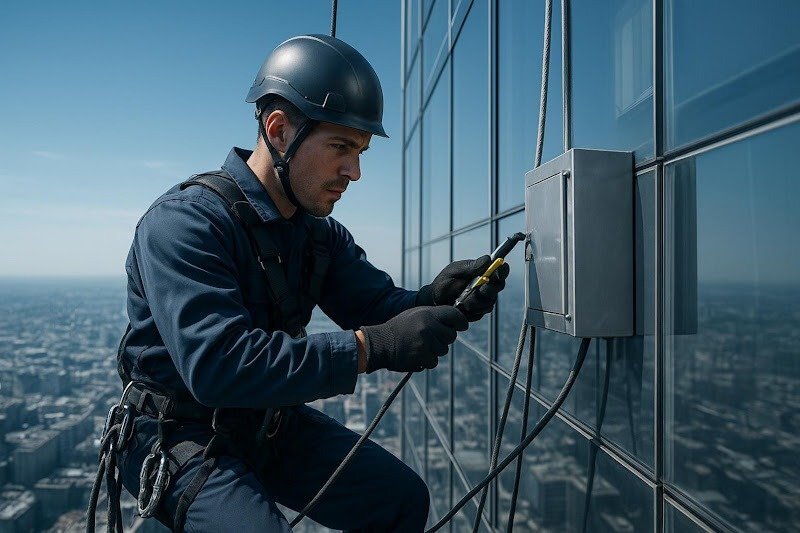
Professional rope access electricians work in places where accuracy, skill, and a strong focus on safety matter every day. So, what safety standards do they follow? These specialists work under a wide set of safety rules that include international guidance, local laws, strict electrical codes, and workplace health and safety rules. This layered setup helps keep their work-often done in difficult, hard-to-reach spots-efficient and, most importantly, safe.
The job itself-mixing work at height with electrical risks-means they must prepare more than many other trades. Whether they are servicing wind turbines, checking offshore oil platforms, or fixing wiring on tall building exteriors, every rope access electrician is trained to lower risk through careful planning, the right equipment, and regular training updates.
Why Do Professional Rope Access Electricians Prioritize Safety?
For professional rope access electricians, safety is more than a checklist; it guides every task. The places they work can be harsh and unpredictable, with a mix of hazards that leave little room for error. This focus on safety comes from knowing that even small mistakes can lead to serious harm in these conditions.
Unique Hazards in Rope Access Electrical Work
Working at height is risky on its own, but electricians using rope systems also face electrical dangers. They may work in tight spaces, close to live parts, or inside busy industrial sites where scaffolding or lifts are not practical or would get in the way. Because of this, they need training that goes beyond basic fall protection and also covers electrical safety, arc flash protection, and lockout/tagout procedures.
Rope access electricians also deal with weather like wind, rain, and extreme heat or cold, which can make the job harder and raise the risk level. Handling sensitive electrical tools while staying stable on ropes adds more difficulty. Good coordination and constant awareness of what’s around them helps stop accidents before they happen.
Statistics on Rope Access Safety
Even though the work has clear risks, rope access has one of the lowest incident rates across work-at-height industries. This record does not happen by chance. It comes from a safety-first culture built into the way rope access is taught and managed. Groups like the Industrial Rope Access Trade Association (IRATA) gather and publish accident and incident data each year, using the results to improve rules and tighten procedures.
Using real data, along with strong risk reviews, backup safety systems, and regular safety checks, makes rope access a very safe way to work at height. It shows that with careful planning and strict rules, even difficult jobs can be done safely.
Which Safety Standards Govern Professional Rope Access Electricians?
Safety for professional rope access electricians is controlled by a strong set of standards that pulls from global best practice and local legal rules. This helps keep safety and skill levels consistent across different sites, protecting both the technicians and the quality of the work.
IRATA, SPRAT, and National Regulations
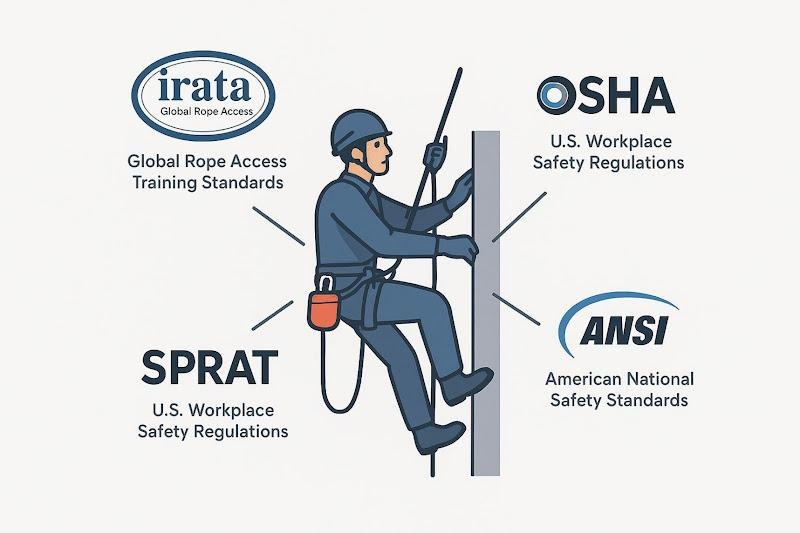
Global rope access safety often starts with certification from major bodies like the Industrial Rope Access Trade Association (IRATA) and the Society of Professional Rope Access Technicians (SPRAT). These groups set strict training and certification steps that are recognised internationally. Even so, SPRAT-certified technicians, for example, must also follow the rules of the main regulator where they are working. In the United States, this includes OSHA fall protection rules, especially Subpart D and I of the 1910 General Industry standards, with close attention to sections like § 1910.28 and § 1910.140, which cover personal fall protection systems and anchor requirements.
Rope access is also covered by the American National Standard Z459.1 (Safety Requirements for Rope Access Systems), part of the wider ANSI Z359 fall protection code, and ANSI Z359.14 (Fall Protection & Equipment Standards). Around the world, ISO 22846 standards are also commonly used for rope access best practice, helping create a clear and widely shared approach to safety procedures.
Electrical Codes for Hazardous Environments
Because they are electricians, rope access technicians must also follow national and local electrical safety codes. This includes rules for working on or near live parts, working in hazardous areas, and using special electrical equipment. Lockout/Tagout (LOTO) procedures are mandatory to switch off circuits and stop them being turned back on by mistake during repairs or maintenance. These electrical steps are built into the rope access plan so that working at height does not weaken electrical safety.
By combining rope access standards with electrical codes, teams get two layers of protection: one for how the worker gets there, and one for the electrical task itself. This joined-up approach is needed to cut the risks that come with electrical work at height.
Compliance with Occupational Health and Safety Standards
Alongside rope access and electrical rules, professional rope access electricians also follow wider Occupational Health and Safety (OHS) standards. Safety manuals-often called Rope Access Operating Procedures (RAOP)-guide how work is done. One key part is the Risk Assessment and Method Statement (RAMS), which requires each site to be checked in detail for hazards, with control measures put in place.
Daily safety talks and hazard updates, often recorded through Field Level Risk Assessments, keep teams alert and ready to respond to changes on site. While global and national standards set the overall rules, the employer is responsible for making sure technicians use the right equipment and methods and fully follow the rules in the area where they are working.
How Do Certification Levels Reflect Safety Expertise?
Rope access uses a tiered certification system. Each level shows a higher level of skill, responsibility, and safety knowledge. This helps make sure every team member has the right ability and judgement for the work they are given, which supports the safety of the whole job. While the certification focuses on rope skills, it often matches employer roles like Authorized, Competent, and Qualified Persons, as defined by OSHA and ANSI.
Level I: Rope Access Electrical Worker
A Level I Rope Access Electrical Worker is the entry level for this type of work. They work under direct supervision from higher-level staff. Training covers the basics of rope access, such as going up and down ropes, basic rigging, and emergency steps. They are trained to follow the Job Safety Analysis (JSA) closely and to use only approved equipment. Before each job, they carry out key pre-use inspections of their gear and anchors, knowing this is one of the first lines of safety.
In wider safety role terms, a Level I worker often acts as an “Authorized Person.” They have permission from the employer to do specific tasks and are trained for that scope, but they usually do not supervise or take corrective action beyond reporting hazards.
Level II: Lead Rope Access Electrician
The Level II Lead Rope Access Electrician has more responsibility and often supervises others. They can carry out more complex rope movements and help with more difficult rescues. They oversee Level I workers and check that site safety steps are followed. They also help review anchor setups and confirm that equipment is compatible, acting as a main contact for safety issues on site.
This level often matches the “Competent Person” role: someone who can spot current and possible hazards in the work area and has the authority to act quickly to fix them. Their training and experience allow them to monitor and manage fall hazards and guide safe work methods.
Level III: Supervisor and Safety Manager
The Level III Supervisor is a key safety figure on rope access jobs. These experienced workers often have at least 2,000 hours on rope and manage both safety and operations. They handle planning, rescue readiness, and required paperwork.
A Level III supervisor signs off on inspections, certifications, and compliance reports, and oversees rope access and fall protection work. They lead daily safety meetings, write rescue plans that match the site, inspect gear and anchors, confirm team qualifications, and check logbooks for correct hour records.
If an emergency happens, they lead rescue actions and manage incidents efficiently. This role often fits the “Qualified Person” label, especially if they help design or approve the rope access system, set skill needs, or approve rescue plans. The employer still makes the final call based on the authority given for the specific job.
How Are Rope Access Electricians Trained for Safety?
Training for rope access electricians is ongoing. It builds strong safety habits, technical skills, and emergency readiness. The goal is to make sure every worker is skilled in electrical work and fully prepared for the risks of working at height.
Hands-On Skills and Practical Drills
Rope access training, provided by certified bodies like IRATA and SPRAT, is highly hands-on. Technicians spend a lot of time practising through realistic scenarios. They learn safe ways to go up and down ropes, how to use fall arrest and work-positioning gear, and how to choose anchor points and rig correctly. They practise moving around complex structures, keeping stable work positions while suspended, and doing electrical tasks accurately while on rope.
Drills often include working around obstacles, controlled drops, and practice rescues, plus training on suspension trauma awareness. This approach helps people turn classroom learning into safe real work, building skill and confidence.
Emergency Rescue and Evacuation Training
A major part of rope access training is emergency rescue and evacuation readiness. Everyone on the team needs to know what to do if someone becomes unconscious, stuck, or shows signs of suspension trauma. Training covers self-rescue using prusik cords or mechanical ascenders, and assisted rescues in both vertical and horizontal setups. Technicians learn how to use rescue kits, including pulleys, descenders, and hauling systems.
Timed emergency drills are common, along with training on clear communication with ground teams and emergency responders. OSHA requires a rescue plan to be made and practised for each job, highlighting the need to start and lead a rescue quickly after a fall or medical incident.
Continuous Competency Assessments
Rope access is not a “learn once” job. Skills must be checked and renewed. Technicians must renew certifications, which includes theory and practical testing. Another key part is accurate documentation of rope hours in official logbooks. These logs are reviewed by IRATA or SPRAT during recertification or when moving up a level. This helps confirm that workers have recent, verifiable experience and that only people who are currently capable are doing rope access work.
Refresher Courses and Regulatory Updates
Refresher training is required, especially if a technician has not worked on rope for more than six months. These courses strengthen core skills, explain new equipment, and introduce updated methods. Workers must also keep up with rule changes and technical updates. Standards change over time and often become stricter, so professionals must stay current to keep safety levels high.
Refresher training often happens every 6 to 12 months, or straight after an incident or near miss, or when new gear or techniques are introduced. Regular learning helps teams stay alert, ready to respond, and aligned with current safety rules.
Which Equipment and PPE Are Required for Safe Rope Access Electrical Work?
Safety for rope access electricians depends heavily on reliable equipment and Personal Protective Equipment (PPE). Each item is made, tested, and maintained to handle tough conditions and provide backup safety. Using the right specialist equipment is a big reason rope access has a strong safety record.
Fall Protection Systems
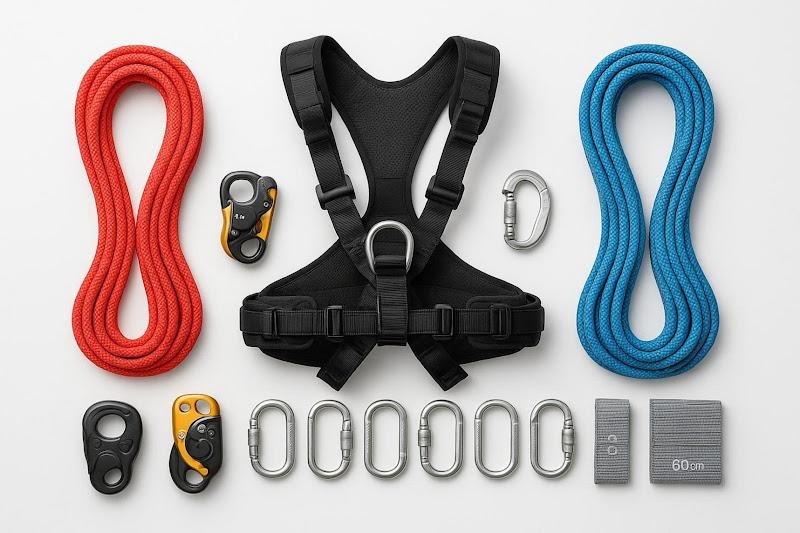
A key rule in rope access is the dual-rope system: one working line and a separate backup safety line, each attached to its own certified anchor point. This backup setup means that if one system fails, the other can stop a fall. Technicians use full-body harnesses that must be ANSI Z359-approved, so fall forces are spread safely.
The system also includes descenders, ascenders, and backup devices that lock automatically if a slip happens. Ropes (static for positioning, dynamic for fall arrest) are rated for heavy loads. All connectors and carabiners must be rated to at least 5,000 lbs and must be connected to certified roof anchors that need yearly inspection and certification.
Electrical Insulation and Arc Flash PPE
Fall protection is only part of the safety needs. Rope access electricians also need PPE that protects against electrical hazards, including arc flash events. This includes insulated gloves, safety glasses, and arc-rated clothing that can handle high heat and energy from an arc. Helmets protect against impact and may also have electrical insulation ratings.
Clothing must allow movement while fitting well, and it must suit the weather-because being too hot or too cold can affect judgement and movement. Using both fall protection and electrical PPE helps protect workers during tasks near live circuits or energised equipment.
Rope Access Harnesses, Lanyards, and Tools
Beyond the main fall protection system, extra gear helps with the electrical work itself. Some harnesses are made to hold tool pouches and equipment so tools are easy to reach but still secure. Tool lanyards and other drop-prevention items are required to stop tools falling, which could hurt people below or damage property.
New technology is also bringing in “connected PPE,” such as smart harnesses with sensors that can track a technician’s position and alert ground teams or emergency services if there is a sudden jolt, unusual movement, or a fall.
Regular Equipment Inspection and Maintenance
Gear inspection is mandatory and follows several steps. Technicians do an “Acceptance Check” when new equipment arrives, looking for defects and recording serial numbers. Before each job, a “Pre-Use Check” (often a buddy check) includes visual and hands-on checks for wear, damage, or faults-this is the most common protection against gear failure.
“Detailed Inspections” are done by a qualified PPE inspector every six to twelve months (based on the manufacturer) and must be recorded. “Interim Inspections” are also done in high-stress conditions or after any incident to confirm the gear is still safe.
All items-harnesses, ropes, connectors, and anchors-are logged and tagged, supporting a simple truth: a rope system is only as safe as its last inspection. This disciplined approach to equipment management is exactly what professional providers like Rope Access in London rely on to keep every technician safe at height.
What Are the Key Steps in Rope Access Safety Procedures?
Safe rope access electrical work depends on a set of planned procedures. These steps help teams spot hazards, judge risks, and reduce them at every stage, from planning through to the end of the job.
Risk Assessment and Job Safety Analysis
Each rope access electrical job starts with careful planning, including a Risk Assessment and Method Statement (RAMS). This means checking the site for hazards, reviewing the strength and condition of anchor points, and looking at weather conditions such as wind, rain, or dust.
A Job Safety Analysis (JSA) is then used to split the work into steps, list hazards for each step, and set control measures. These checks help workers understand why safety rules exist and make sure controls are set before anyone starts work.
Permits to Work at Height and on Live Circuits
Rope access electricians often need permits for working at height and also permits for work on or near live electrical systems. These “Permits to Work” act as important admin controls, confirming that safety steps are in place and that the correct people have approved the work. This may include confirming Lockout/Tagout (LOTO) is active, circuits are switched off, or arc flash controls are in place if live work cannot be avoided.
Permits help formalise the risk controls and stop work from starting without clear approval and clear limits.
Safety Checks Before, During, and After Work
In rope access, awareness must stay high throughout the job. Before work begins, technicians do two main checks: a self-check of personal gear and a buddy check where a coworker verifies the setup. During work, teams keep watching the condition of equipment, anchors, and weather. Level III supervisors oversee the job and carry out regular checks while watching technician movement.
After work, equipment is checked again, cleaned, stored correctly, and logged so there is a clear record of use and inspection. This routine builds safety into every stage of the work.
Two-Rope System and Redundancy Principles
The main safety idea in rope access is redundancy-having a backup for every key safety part. The clearest example is the required two-rope system: a working rope and a separate backup rope, each on its own independent anchor. If one fails, the other prevents a fall.
Redundancy also applies to harnesses, connectors, and backup devices. Safe anchor selection, planned rigging, and built-in rescue plans are also part of this layered protection. This approach cuts risk and helps technicians work in hard-to-reach places with control and security.
How Is Rescue Planning Integrated into Rope Access Electrical Projects?
Prevention is the main goal, but professional rope access teams always prepare for emergencies. Rescue planning is built into each project so that if something goes wrong, the response is quick and effective.
Site-Specific Emergency Protocols
For every rope access electrical job, the team creates a clear rescue plan. This is not a generic document; it is written for the specific site and the risks there. The plan covers access and evacuation routes, taking into account the structure layout and any barriers. It also sets communication steps and medical response actions, so the team can work smoothly with ground staff and outside emergency services.
These plans must be documented, reviewed, and often practised through emergency drills. If a technician becomes unconscious, stuck, or shows signs of suspension trauma, the team already knows the steps to follow, which reduces panic and improves the chance of a safe outcome.
Rescue Equipment and Crew Readiness
Rescue planning also means having the right gear and the right people ready. Rescue equipment-such as pulleys, descenders, and hauling systems-must be on site and, where possible, set up in advance. A trained Level II or Level III technician must be present to start or lead a rescue immediately after a fall or medical emergency.
These technicians are trained in self-rescue, assisted rescues in different setups (vertical and horizontal), and more difficult rescue situations. The full crew is also trained on their role in an emergency, helping the team respond quickly and calmly.
What Are Common Rope Access Safety Mistakes and How Can They Be Prevented?
Even with strong training and planning, errors can still happen. Knowing common safety mistakes in rope access electrical work helps teams prevent them and stick to safe methods. By spotting these issues early, teams can put strong controls in place to avoid them.
Overlooking Electrical Lockout/Tagout Procedures
One of the most serious (and sometimes fatal) mistakes is skipping or doing Lockout/Tagout (LOTO) incorrectly. This can cause circuits to become live by accident, leading to shock, arc flash, or death. Prevention depends on regular training for the site’s specific equipment and strict use of permits for electrical work.
A competent person must verify that power sources are isolated and de-energised before work begins. Supervisors must closely monitor these steps and create a culture where LOTO is never rushed.
Improper Anchorage Selection
The whole rope system depends on safe anchors. Common errors include using anchors that are not certified, choosing points that are not strong enough, or failing to keep enough separation between the working and backup lines. These issues can cause anchor failure, serious falls, or tangled ropes. Prevention starts with planning and requires a Level III supervisor to assess and approve anchor points.
Yearly roof anchor certification is required for tie-off systems, and technicians must report any weak or questionable anchors. Using two separate anchor points-one for the working line and one for the safety line-each strong enough to hold the load on its own, is a fixed rule.
Complacency with Equipment Checks
Complacency can lead to skipped checks or rushed inspections. Missing daily pre-use checks, ignoring scheduled detailed inspections, or skipping interim inspections after heavy use can mean damaged gear stays in use. Overlooking visible wear on ropes, harnesses, or connectors can lead to failure.
Prevention means building a clear safety culture: daily toolbox talks that repeat the importance of checks, open reporting of problems without blame, and regular audits and refresher training. Technicians must treat gear checks as non-optional, because their safety depends on it.
Frequently Asked Questions About Safety Standards for Rope Access Electricians
Is rope access safer than scaffolding or lifts for electricians?
Yes. When run under certified supervision and strict rules, rope access often has one of the lowest incident rates in the industry and can be safer than scaffolding or lifts. This comes from careful planning, the built-in backup of the two-rope system, and strict training and certification. The controlled setup, along with strong risk reviews and planned rescue methods, helps reduce risk-especially on complex sites where other access methods can create extra hazards.
How often should rope access electrical equipment be inspected?
Rope access electrical equipment follows a multi-step inspection process. An “Acceptance Check” is done when new gear arrives. A “Pre-Use Check” is required before every job or shift, often including a buddy check. “Interim Inspections” are carried out after any incident or after use in high-stress conditions. A “Detailed Inspection” by a qualified PPE inspector is required yearly, or every six to twelve months depending on the manufacturer and local rules. All inspections must be recorded, and any item with wear, damage, or faults must be taken out of service straight away.
What certifications are mandatory for rope access electricians?
Professional rope access electricians usually need rope access certification from IRATA (Industrial Rope Access Trade Association) or SPRAT (Society of Professional Rope Access Technicians), commonly from Level I (Worker) to Level III (Supervisor). They also need training that matches general workplace safety standards, such as OSHA 1910 and ANSI Z359 in the United States. Employers also assign job roles such as “Authorized,” “Competent,” or “Qualified” persons based on the responsibility and authority given for that job. This goes beyond holding a certificate and includes job-specific knowledge and experience.